! POST IN TRANSLATION !
We summarize below the 7 music proposals we did in the 3 workshops in Leipzig, February 17th and 18h : The circle, Ouganda style, Working with blocks, Graphic scores, Rhythm in opposition, Prepared instruments and Numbers as rhythm.
With a little foreword to begin and, at the end, some resources and links about this proposals (navigation with [↑] and [↓]).
Before anything
To begin, two considerations:
● We’ll try to make music and sounds unusually, differently than in most widespread way, at least to begin. For example, the melody, pitch and harmony are a very common way of thinking, analyzing and so creating music, but we could also put emphasis on other parameter such as sound, timbre or rhythm.
Wadada LEO SMITH speak often about music as “sound-rhythm”. There’s a play-on-word in english, where sound could also be an adjective, as in a sound health (good health) or a sound idea (intelligent, sensible, reasonable).
Henry KAISER wrote: “Rhythm, melody, and harmony have always been the least interesting aspects of music to me. I’ve always been more interested in timbre, shape, timing, space, emptiness, structure, emotion, color, and expression” [in Arcana III: Musicians on Music, John ZORN (ed.), New York: Hips Road, 2008, p103].
● We have in mind that, after the meeting in Paredes de Coura in July, we will have a large group. Next October, we will be more than 20 people playing music together: it changes the practice and organization of sounds.
Music Proposals
The circle
The group is in a large circle (without a music instrument to begin, but we can take them after to go on). The goal is to explore collective sound production with everybody in a more equal position than behind an instrument more or less controlled.
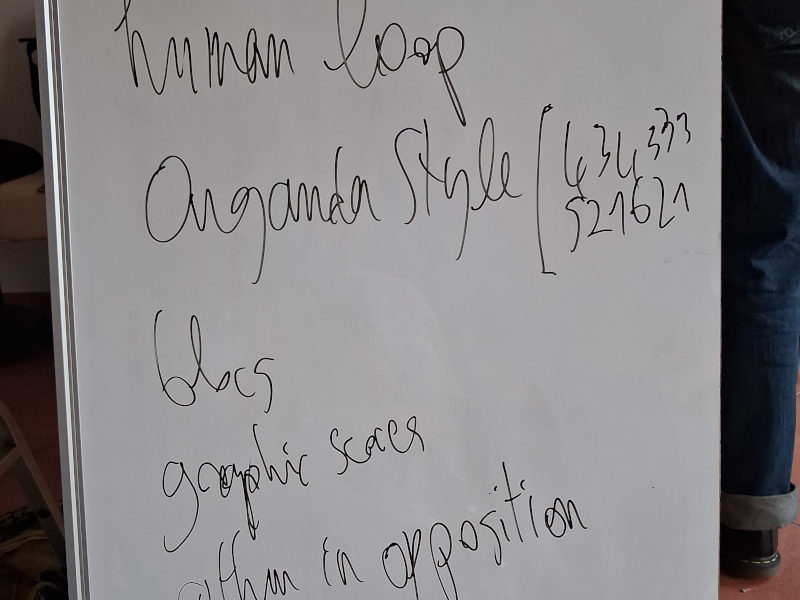
- Build a human loop: each participant makes a sound when passing the current to a neighbor.
- Stepped Development, by adding a second Floor: each participant keeps his·her own sound, and add a different sound with another participant in the circle.
- Organization in different blocks: each round can have particular instructions gigging a special color.
For example, 1 round with short loud sound, 1 round with short soft sound, 2 rounds with long sound, with the first one in crescendo, then a moment like “this morning” (where everybody explain what s·he did this morning as fast as possible in your mother tongue), then the 1st round with short loud sound.

Ouganda style
Inspired by an Ouganda’s way of writing (we’re still not able to refind it on the net!), play two ideas:
- A is 12 notes played regularly
4 3 4 3 3 3 4 3 4 4 2 2, and we choose: 4 is a E, 3 is a A, 2 is G. - B is 6 notes played regularly
5 2 1 6 2 1, with 5 as a C, 6 a D, and 1 is a low E.
Rhythmically: the 6 notes formula (B) could be one bar 6/8, or one bar 3/4. The 12 notes of the A are two times longer.
Harmonically: the chosen pitches are taken from the C major pentatonic (or the A minor one), but with a little emphasis on the E.
The coding “a number=a pitch” could be used differently.
Working with blocks [↓]
Define and characterize some blocks of sounds-type of music, and play with them on cue or in a structure already written, etc.
Graphic scores [↓]
Playing a graphic score is interpreting any picture as a score, a visual representation that could give us instructions and ways of organizing sounds together.
Rhythm in opposition
Play one note regularly, every one with the same tempo. It’s quarters.
At some moment, anyone can add an eight note and continue regularly with quarter after.
Something like…

Play and vary pitch, intensity, play/not play by groups, add little solos on the collective rhythm, etc.
Prepared instruments [↓]
Numbers as rhythm [↓]
This time, the numbers are a code/indication for rhythm. For example, “3” is thought as “ONE, two three” played regularly, but only the ONE is played with an accent.
We can add and combine different numbers for different parts. In large groups, short sound of each ONE is generally preferred to hear all, but some of the numbers can be long sound.
For example, a 3331+55+424 (a meeting point each 10 subdivisions) with the first 5 long could be represented like:

Nicolas, for the French Team (April, 20th 2026).
Some details
Working with blocks? [↑]
Working with blocks is an old way of making music (for example, Igor STRAVINSKY’s music is often analysed as blocks), and a very common (sequenced music dealing with audio and/or midi in a rectangular unit, a block, placed in a timeline, or pads materializing units and blocks). A lot of composers like sudden and potentially surprising shifts. These are often challenging in collective improvisation, so improvisers like them too. See, for example, John ZORN’s compositional techniques, such as “Speedfreaks,” a hardcore-miniature composition which goes to the extreme of series-of-little-music-cells, for the band Naked City (which also explores other compositional approaches), or the rules of improvisational games like “Cobra” (where one person acts as a prompter, gathering the group’s ideas and organizing them, notably using cue cards), or his file card compositions (on a subject, research creates many cards —one card, one sound “thing”—, then he orders them and goes in studio).
“Speedfreaks” (Naked City) in studio, and a live performance.
John Zorn’s way of thinking in blocks, some explanations:
- about his file card composition “Spillane” and musics for cartoons (coming from the documentary Put blood in music, about New York, John Zorn and Sonic Youth, by Charles ATLAS, 1989, circa 12’05-18’40);
- and here with some extracts of “Cobra” rehearsal (coming from the documentary On the edge, Part 1, Passsing it on, by Derek BAILEY, 1992, circa 20’01-29’06).
Graphic scores? [↑]
The 2nd digital edition on PAALABRES (Artistic Practices in Acts, Laboratory of Research) web site is made with a lot of realizations and descriptions, analyzes. “The use of graphic scores is today widespread in extremely varied contexts and aesthetical modes of behavior.” (PaaLabRes, 2017).
There’s so many examples… see some kind of a tidying and a list, made 50 years ago and from a very classical and contempory music point of view but impressive. But we can speak about Treatise by Cornelius CARDEW (1963-1967, 193p hand written with an very important “no instruction!”), and those of Fred FRITH (instruction built by interpretation of photo, see the record Stone, Brick, Glass, Wood, Wire (Graphic Scores 1986-96), I Dischi Di Angelica, 1999), and the beginning of the interview of Pascal PARIAUD.
Prepared instruments? [↑]
John CAGE is a very well known composer, so the prepared instrument is very often linked to him. He has been developing the prepared piano since 1940. “The story of Cage’s invention of the prepared piano is fairly well-known. In 1940, while a dance accompanist at The Cornish School in Seattle, Cage was working mostly with percussion music. When one of the dancers, Syvilla Fort, asked Cage to write the score for her dance Bacchanale, she surely expected a percussion work. However, the concert was to be held in a space too limited for the battery of instruments that Cage typically used. All he would have at his disposal was a piano. The music he had in mind did not lend itself to the clear pitches of the piano, so Cage found a way to alter the piano to make it sound more like the percussion instruments he favored. He wedged bolts and pieces of weather stripping between the strings of the piano, muting the tone and creating more complex, inharmonic timbres. After this discovery, ‘I wrote the Bacchanale quickly,’ Cage recalled, ‘and with the excitement continual discovery provided.’” [James PRITCHETT, in “John Cage and the prepared piano: a twelve-year history in six parts”, 2007].
It is said that Erik SATIE put papers in the strings of the piano in 1913 (Le piège de Méduse).
But everyone that adds/removes objects, that acts on a special part of the instrument does almost the same: the hand in the bell of the french horn (already known and used in the XVIII century), the different mutes for trumpet or cello, find harmonics, double tones, etc. The apparition of electric, electronic and digital tools multiplies ideas (the electric guitar is a nice example).
We can play our instruments differently and find new sounds.
Numbers as rhythm? [↑]
Numbers can indicate a pitch, but also indicate rhythmic instructions.
Let say that “3” is “one, two three” played regularly,
… with an accent on the one: “ONE, two, three”
… and without the two and three, only the ONE is played…
A succession of representations with the example 3331+55+424 (a meeting point each 10 subdivisions),
with all counts:

with only the accent on the “ONE”:

with the first 5 long, all others short: