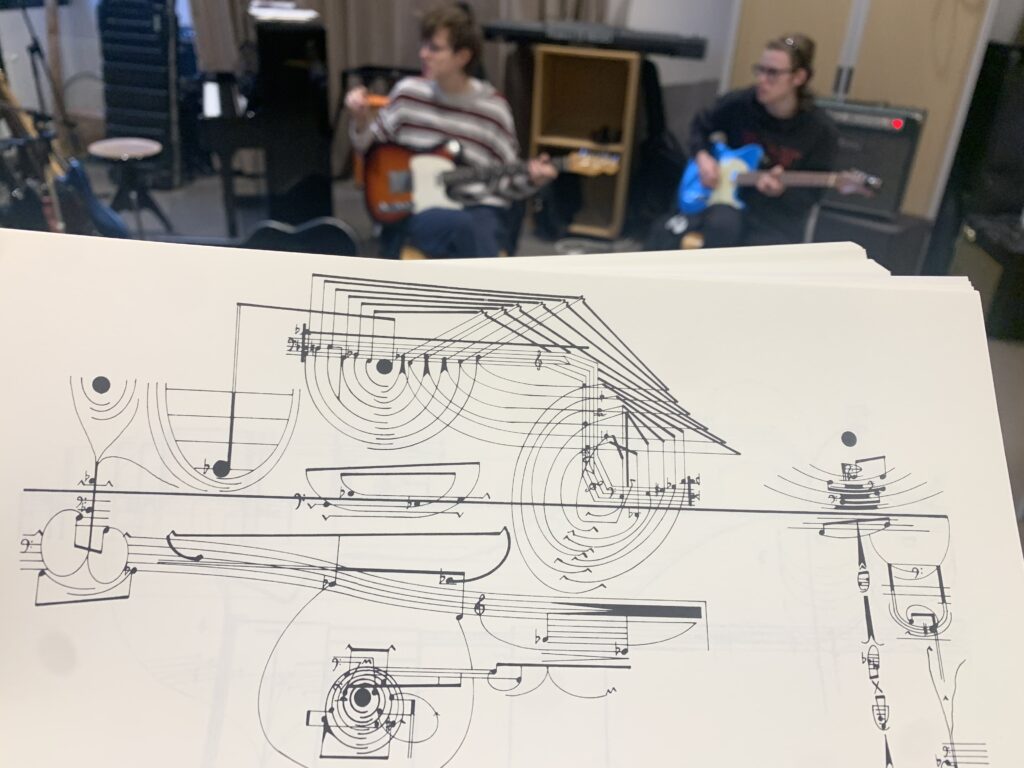
Rehearsal #1 – January 16th 2026
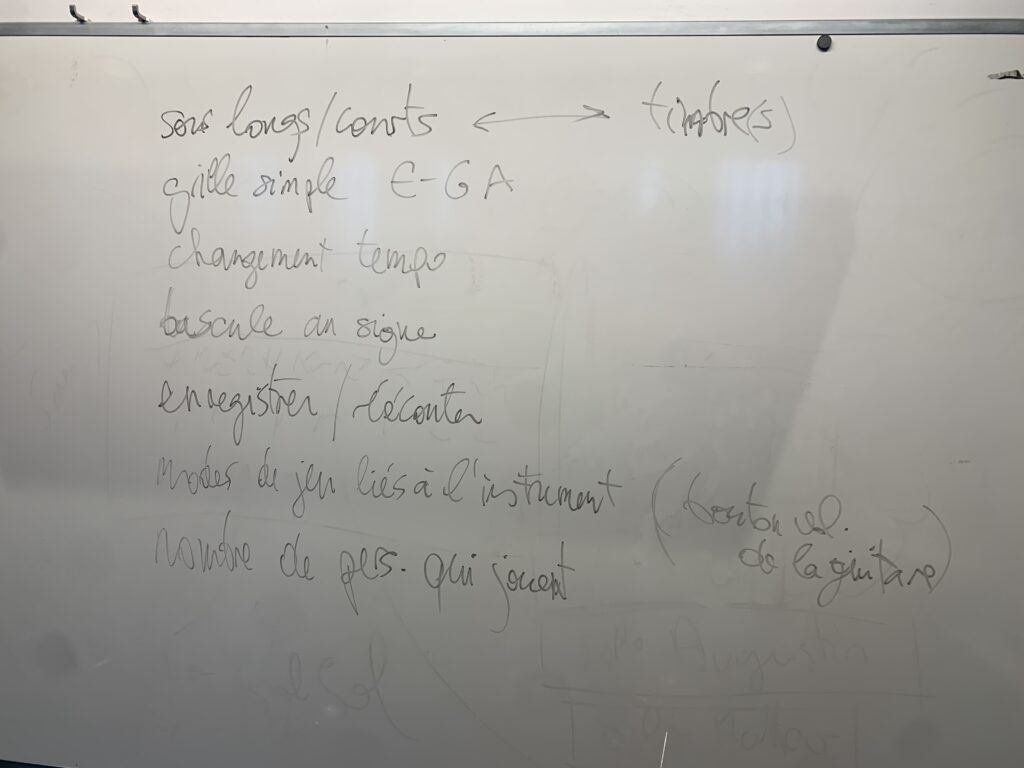
Second rehearsal — Friday, 23 January 2026
10:00 a.m. – 12:00 p.m.
Present: Lise Donandieu, Eoghan, Loula, Antoine
Absent/excused: Lucy (ill) and Julie
Nicolas Gilles
We start with a round of introductions, as Lise and Antoine were not at the first rehearsal.
Each person introduces themselves briefly:
-
How old are you?
-
Where did you grow up?
-
What do you currently do in life?
Idea to get to know each other:
Everyone fills out a short profile sheet:
-
My name is…
-
I grew up in…
-
I live in…
-
What is my main instrument?
-
How long have I been playing?
-
Other instruments I play?
-
Other artistic practices?
-
Am I in a band / bands?
-
What musical style do I prefer?
We talk again about the first rehearsal. Most people listened to it, but nobody really suggested starting again from that session (we keep those recordings in the WhatsApp group created during the first session).
We discuss the project and the fact that we will meet as a large group in Leipzig:
-
2 or 3 French participants, 2 Portuguese, 7 Germans (and 6 educators)
-
We don’t know the German and Portuguese participants yet, nor their instruments or “level”
We need to bring musical proposals for the workshops in Leipzig.
Reminder:
-
In Leipzig, the French group brings musical proposals.
-
In Parades de Coura, the Germans bring musical proposals, continuing from the first meeting.
-
In Villeurbanne, the Portuguese bring musical proposals, continuing from the other meetings.
How can we imagine proposals that are easy to carry out with a large group?
Gilles and Nicolas share their experiences and give some leads.
For example, during the first session we talked about short or long durations, speeding up or slowing down, density, etc.
Gilles also mentions simple composition formats that can go through writing.
For example, in Javanese gamelan notation each note corresponds to a number, and all traditional music is built around two modes: Pelog and Slendro. Gilles plays the Pelog mode most commonly used in Java. We could keep the idea of a “note reservoir” (a mode that we invent, or that we “borrow,” as the basis for a composition). Gilles will provide some information about Javanese gamelan in the “resources” folder on the website.
Gilles also gives an example in a traditional Ugandan music style:
-
Okunaga: 4.3.4.3.3.3.4.3.4.4.2.2
-
Okwawula: 5.2.1
We decide to start from this proposal (A): we assign notes to the numbers and begin the rehearsal.
The idea is not to try to make Ugandan music, but simply to use this as a possible entry point and see where it can take us.
We explore: each person tries playing one part or the other.
The synth sounds feel good and bring interesting additional colors, ranging from percussive sounds to pitched or unpitched sounds, from very low to very high.
We try several “organizations,” then allow new ideas to emerge.
Lise makes a proposal that seems to work and that everyone likes: a new cycle (B).
As we analyze it to understand it, we realize it lasts 8 eighth-notes, while the other cycle runs over 12 eighth-notes. The offset that is created works very well. Playing A and B together, we notice that to come back together, it takes 2 A for 3 B.
Little by little we let go of A and improvise around B.
Eoghan and Gilles use “chouchous” (hair elastics) to modify the sound of their guitars (elastic placed at the 12th fret, and playing on the neck section before the 12th fret).
Toward research on “prepared instruments”?
To be completed for next time…
At the end of the rehearsal, we suggest that everyone bring composition ideas, even very simple ones, for the next rehearsal.
Rehearsal#3 — 9 February
Eoghan, Lise, Lucy, Julie, Loula
We review the last rehearsal and the trip organization: how to manage the first musical meeting?
We listen again to the recordings, explaining the structure to Lucy and Julie:
A: 4 3 4 3 3 3 4 3 4 4 2 2
B: 5 2 1
We find again the 4/4 part (C) proposed by Lise last time.
We loop everything and try the “turnaround” in 4 on part A, then on part B.
We then propose an “organization”:
-
The guitars start on B; the “basses” join on A.
-
Each person takes a solo (takes the floor), tries things out.
-
Then we switch roles: the basses play B, the guitars play A.
-
Lise and Eoghan bring in part C.
-
Gradually, everyone joins the 4/4 proposal.
Loula suggested chords that seem to work well.
PS: While listening again to the previous rehearsal, I found a passage on C that I think works well—possibly Antoine on synth who suggested it (I added it to the audio takes). This could be a lead for the next rehearsal.
We have to stop at 4:30 p.m.: reduced opening hours during the holidays and the director refused to let us stay without supervision.
We meet again on Wednesday from 1:30 p.m. to 4:30 p.m. for a final rehearsal to prepare the Leipzig workshop.
A short but effective rehearsal.
PS: Lucy suggested inviting a drummer friend to join the group. The project seems to interest him, but he didn’t come to this rehearsal—maybe next time?
PPS: You also have the introduction/presentation of the Portuguese participants who will join us in Leipzig.
VIDEOS :
#3 Nomades
Presentation of the Portuguese participants who will join us in Leipzig.
NOMADES – space ensemble team for Leipzig