! POST IN TRANSLATION !
Musical proposals (in Paredes de Coura , July 2026)
The two-day music workshop was facilitated by the Leipzig team. In preparation, the music educators Nora and Ridchi met with the German participants Lisa and Ludvig in Leipzig to discuss their goals and expectations for the workshop. Together, they defined several guiding objectives, including collaborative songwriting, working with texts and a theme, creating space for personal expression, exploring experimental musical approaches alongside structured musical forms, and emphasizing the
creative process over the final outcome.
Day 1:
Icebreaker: Name Circle with Sound
The day started with a rhythmic name-learning game. Following a steady pulse, participants took turns saying their names, while the whole group repeated each name in a call-and-response pattern.
In the next round, participants introduced their names together with a short clapping pattern, which the group echoed in a call-and-response. Afterwards, the group collectively called out each participant’s name while maintaining the steady pulse. The game was repeated in a final round, each participant naming the instrument they would be playing during the workshop.
The activity established a shared sense of rhythm and provided a playful way for participants to learn and
remember each other’s names and instruments.
Icebreaker: Getting-to-Know-You – Space Walk
The group continued with a movement-based warm-up. All participants moved freely through the room and stopped whenever the facilitator gave a signal. During these pauses, they engaged in different body stretches and relaxation exercises before starting to move through the space again.
While walking, participants were encouraged to interact with each other in different ways, including greeting one another through various gestures, as well as to walk at different speeds.
During the following stops, participants who were standing close to each other paired up and had short
conversations based on different questions, such as:
- “Why are you here?”
- “If you were a song or a piece of music, what would you be and why?”
- “What do you like most about your city?”
- “What do you enjoy most about making music?”
The activity combined physical awareness, playful interaction, and personal exchange, helping participants connect with each other in a relaxed and creative way.
Circle Drumming/Grid-Groups-Shapes
The workshop began with a shared Circle Drumming session, in which the participants worked with various percussion instruments while sitting in a circle. At the beginning, the focus was on the conscious perception of sound and the group. Using their fingertips, the participants created individual impulses on their instruments and passed them around the circle from person to person. From there, different fundamental musical parameters such as dynamics, tempo, timbre and density were gradually
introduced.
As the session progressed, these individual impulses developed into fixed rhythmic structures. Different rhythms were gradually established and combined, creating several overlapping rhythmic layers. The entire musical process was facilitated nonverbally. Gestures, eye contact and physical cues were used to communicate entries, changes and transitions. This placed a particular emphasis on group awareness, mutual attention and musical communication.
The Circle Drumming then transitioned smoothly into a concentration and attention game using words, exploring the connection between language and rhythm while also providing a bridge to the following exercise.
In the second part, we explored grid, groups and shapes in rhythm. The basis was a continuous sixteenth-note grid, on which different rhythmic groupings could be experienced and performed. The words “Radio” for groups of three, “University” for groups of five and “Listen to the Radio” for groups of seven were used to establish the different groupings through speech.
Language served as an anchor, making the resulting polyrhythms easier to hear, vocalize and understand before transferring them to the instruments. Only the first note of each group was played. For example, in a grouping of three based on the word “Radio,” the instrumental impulse was placed on “Ra-”, while the remaining syllables helped to represent the underlying rhythmic structure.
This approach allowed more complex rhythmic layers to be experienced physically, verbally and musically. The participants moved between speaking, listening and playing their instruments, gradually becoming more confident in locating the different groupings within the shared sixteenth-note grid.
To conclude the workshop, the previously explored groups of three, five and seven were combined and performed simultaneously. The different groups played their respective rhythmic structures with and against one another, creating a complex polyrhythmic texture. This required the participants to maintain their own rhythmic pattern while simultaneously listening to and perceiving the other rhythmic layers.
Overall, the workshop combined collaborative music-making, nonverbal communication, concentration and attention with a practical and embodied approach to rhythmic structures and polyrhythm.
Creative writing: Haiku
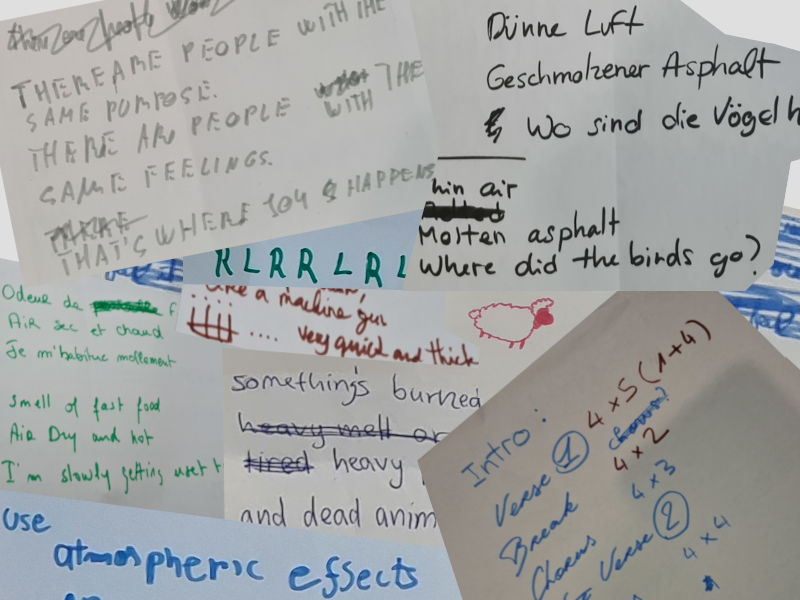
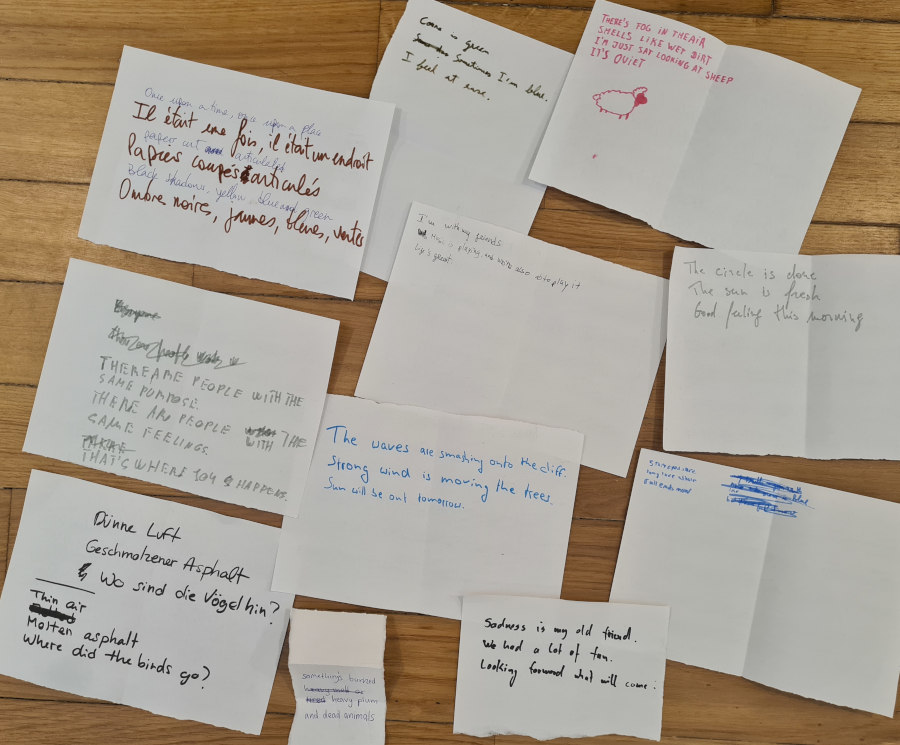
The morning ended with a creative writing exercise. Each participant was given two pieces of paper. On the first, they were asked to write a short haiku expressing a personal impression of a special memory, such as a place or an encounter.
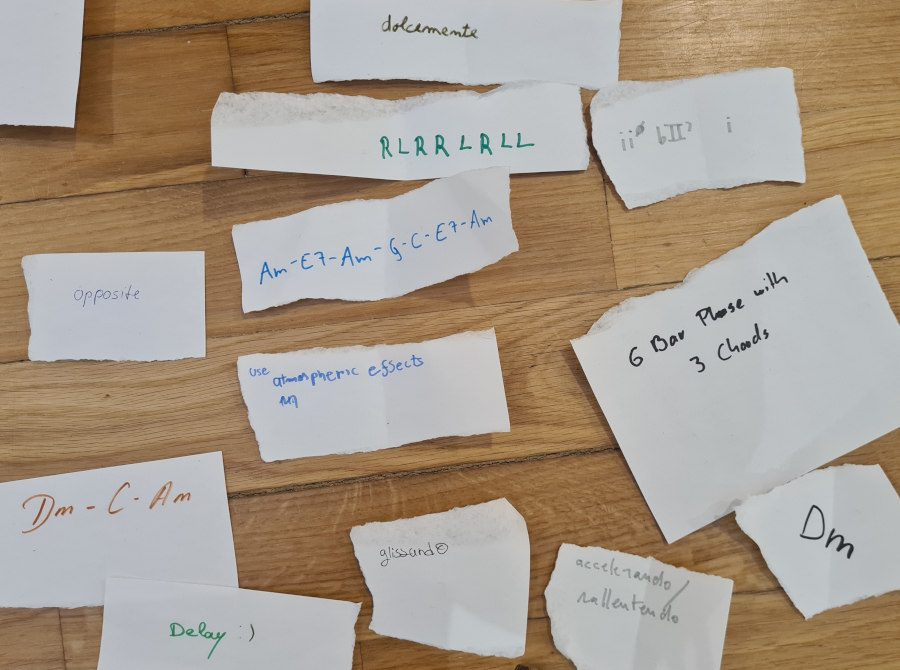
On the second, they were asked to come up with a technical musical element, for example relating to volume, note duration or dynamics. The way in which they represented their musical idea was deliberately left very open. This could take the form of drawings, and song examples were also used.
Afterwards, the participants formed two groups, with each group drawing one paper containing a haiku and one containing a musical element. After the lunch break, the groups experimented with different approaches and used the two papers as inspiration and a starting point for songwriting and musical improvisations.
Group 1: Songwriting
Group Participants: Diogo (Guitar, Effects), Eoghan (Guitar, Effects), Francisca (E-Bass), Juliana (Keyboard, Effects), Loula (Vocals, Lyrics)
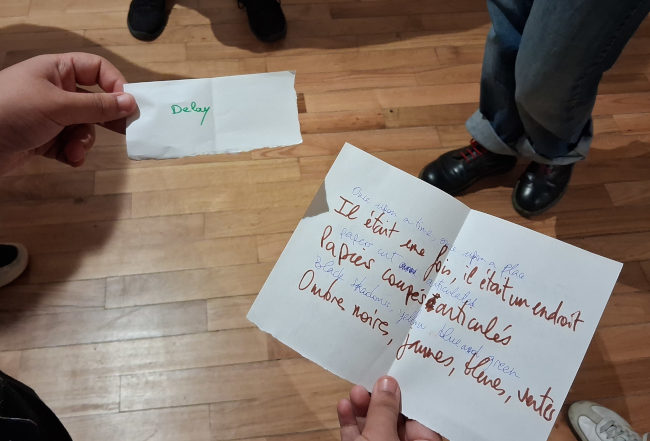
During this session, the group created an original song based on the haiku and the musical element
they drew: Delay.
The participants first explored their interpretations of the haiku, discussing possible associations, images, and musical approaches. The text inspired ideas around a specific atmosphere, landscape, different colors, and contrasts, which were then translated into musical structures, textures, and lyrics.
The group began experimenting with delay effects as a central musical element and explored different noisy textures and sound effects on the guitars and keyboard. These elements were later integrated into partly improvised atmospheric intro and outro sections. Through further experimentation, the group developed a bass riff around which they built the main parts of the song. The instrumentalists developed harmonies and a rough structure for the verses and chorus while the vocalist created vocal melodies and wrote personal lyrics inspired by the atmosphere of the piece and the haiku. At the end of the afternoon, the group had finished the first sketch of their song.
|
Haiku Once upon a time, once upon a place Musiclal Element: |
|
Group 2: From improvisation to composition
In this part of our workshop we focused on the theme “From Improvisation to Composition.” The participants spread out across the available instruments – guitar, drums, bass, piano, voice and synthesizer – and immediately started with a free jam session. For this first round, we deliberately made no musical agreements beforehand: there was no defined key, count-in, predetermined form or distribution of musical roles. The only starting point was the act of making music together spontaneously.
Afterwards, we reflected collectively on the experience of this first improvisation. The main question was: What kind of framework helps each individual participant feel comfortable and secure when improvising freely? Suggestions included agreeing on a key beforehand, using a count-in, or being mindful of the overall volume.
These individual needs were then taken into account and incorporated into the following sessions. The aim was to create a shared space in which everyone felt comfortable enough to explore their own musical ideas, respond to impulses from others and allow unexpected things to happen. The agreed framework was not intended to restrict the improvisation, but rather to provide a foundation from which greater musical freedom could emerge.
Over the course of approximately two hours, a wide variety of musical situations and pieces developed in this way. Ideas emerged spontaneously, were picked up by others, transformed, developed further or sometimes abandoned altogether. The focus gradually shifted from individual playing towards active listening and collective musical creation. Through this process, recognizable structures, dynamics, roles and forms began to emerge from the free improvisations – introducing compositional processes directly into the collective playing.
During the final sessions, we incorporated the game “King and Queen” into the improvisation. One person became the King or Queen through eye contact and temporarily took on the role of musical leader. All other participants then directed their playing entirely towards that person. The aim was not simply to accompany them, but to adapt the sound, dynamics, rhythm, playing style and musical function of their own instrument to the instrument and musical impulses of the King or Queen.
The King or Queen could then pass the leadership role nonverbally to another participant through eye contact. As a result, the musical focus and the distribution of roles within the group continuously shifted. The exercise required a high level of attention, musical awareness, flexibility and nonverbal communication.
In this way, the workshop explored how free improvisation can gradually develop into structured music through listening, responding, collective decision-making and shifting musical responsibility. Composition was approached not primarily as a predetermined result, but as a process that can emerge directly from collective improvisation and interaction within the group.
Day 2:
Warm-up
The second day began with a collective warm-up. The group was invited to contribute ideas for activities that could warm up the body and voice. Different participants took the initiative at different points. The session initially took place in a circle and included facial grimaces, physical loosening and tapping exercises, and breathing exercises.
A participant then suggested a perception and movement exercise known from theatre practice. The participants gathered closely together to form a “swarm.” One person began to introduce movements, as slowly as possible so that the group could stay together and the distinction between the person initiating the movement and those following gradually became less visible.
The group then moved through the space, with the shape and direction of the swarm continuously changing. Ideally, the direction of the movement shifted between different parts of the group, allowing different participants to take on the role of initiating movement.
The exercise was new to most of the group and placed a stronger emphasis on giving and recognizing impulses than the preceding warm-up exercises. It therefore added another dimension to the warm-up, focusing on perception, responsiveness and collective movement.
Musical improvisation games
The following games aimed to encourage the participants to engage in musical experimentation and free improvisation while developing their listening skills, musical communication within the group, and creativity.
For this session, the group sat in a circle with their instruments (guitars, bass, percussion, found objects, vocals, synthesizer, and keyboard).
Sound Imitation Circle
One participant plays a sound on their instrument. The next person in the circle imitates the sound as precisely as possible on their own instrument. The sound is then passed around the circle until every participant has reproduced it. The exercise is repeated several times, with different participants introducing new sounds and with variations in tempo.
Sound Actions
Each participant has two sounds available: one short sound and one long sound. Each sound may only be played once during the piece. Participants decide individually when to contribute their two sounds. The exercise is repeated several times, allowing participants to change their sounds and varying the duration of the piece. The result is a highly transparent group improvisation with distinct sonic interventions, moments of silence, and an increased awareness of timing, space, and collective suspense.
Start / Stop
As a contrast to the previous exercise, the next game requires participants to play continuously with only one rule: the group should begin and end playing as simultaneously as possible. The result is a musical “storm” that suddenly appears and disappears. The exercise is repeated several times until the group develops a heightened awareness of one another’s presence and non-verbal cues.
Tutti / Duo / Tutti
This game alternates between full-group playing (tutti) and duo improvisations. As in the previous exercise, the group begins by playing simultaneously. One after another, participants stop playing until only two players remain. These two musicians continue in a duo improvisation while the others listen. After some time, the group collectively decides to re-enter and begin playing together again. The same process is repeated until another pair of players remains to create a new duo.
Without further instructions from the facilitator, the improvisation may gradually develop its own direction. Trios or quartets may emerge spontaneously, and the tutti “storm” can evolve into a more gradual layering of sounds rather than a sudden collective entrance.
This exercise resulted in a series of improvised pieces with a highly contrasting and transparent character, leaving space for individual expression and unexpected duo interactions to emerge (such as synth and acoustic guitar, water container and keyboard). The participants also introduced creative interventions that expanded the musical play through performative actions, such as moving a chair, playing with their feet, or using a neighbour’s instrument. Another interesting aspect was the group’s
ability to shift between experimental sonic aesthetics and more structured rhythmic and harmonic elements.
——
For the afternoon sessions, the participants joined their group from the previous day to continue their activity. The participants then had the opportunity to join the other group.
Group 1: Songwriting
Group Participants: Diogo (Guitar, Effects), Eoghan (Guitar, Effects), Francisca (E-Bass), Juliana
(Keyboard, Effects), Loula (Vocals, Lyrics)
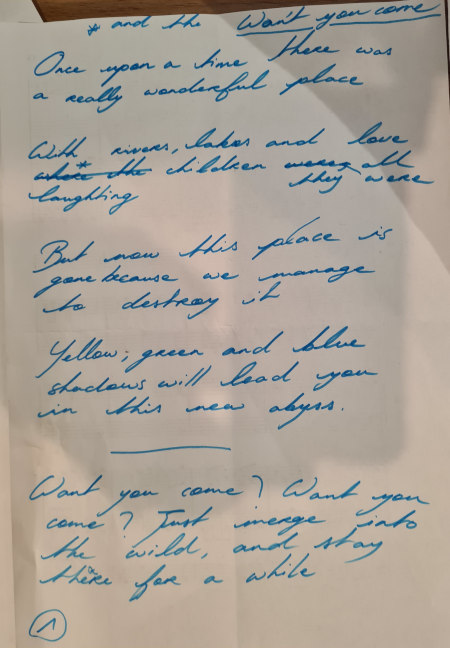
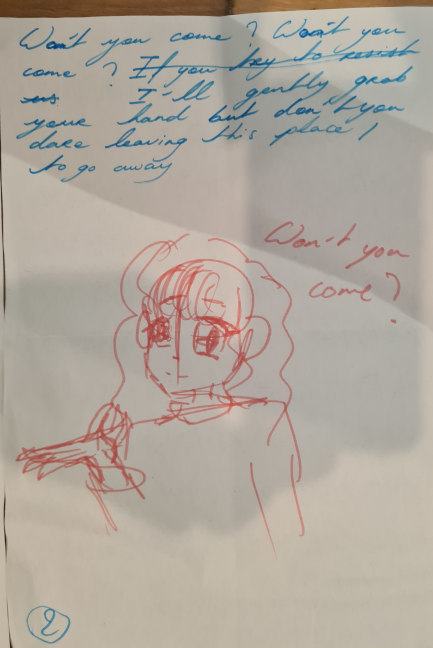
During this session, the group continued working on the song they started creating the day before. They worked on the transitions between the verse, chorus and break parts, as well as on the lyrics and on the final structure of the song. After fixing and rehearsing the details, they did a recording of their finished piece. They called it “Won’t You Come”, and named their group “Shoeglaze”, after one of the keyboard sounds they used.
 |
 |
Group 2: From improvisation to composition
On the second day of the workshop, we built on the experiences and insights gained during the previous day. On the first day, we had already collected haikus and musical forms as a large group, which now served as starting points and creative impulses for working in smaller ensembles again.
In this session, we combined the previously explored principles of collective improvisation – active listening, responding, musical communication and collaborative creation – with the images and atmospheres evoked by the haikus and the given musical forms. Rather than simply translating these images into music, the aim was to use them as impulses for sound, structure, dynamics and musical interaction.
In this way, the free improvisation was expanded by introducing a shared point of reference. The haikus and musical forms provided a framework within which individual interpretations and spontaneous musical decisions could develop into a collective form. This further explored the transition from improvisation to composition: through shared ideas, imagery and structural frameworks, spontaneous musical interaction gradually developed into consciously shaped musical forms.
Nora and Ridchi, for the German team (Sept. 1st, 2026).